
Wallace Projected Versus Actual Release
KDOC calls its public field an “anticipated release date.” It is a calculation based on sentence information and credits then available. The actual release is the custody event that later occurs. Court action, credits, discipline, other sentences, detainers, or transfer can change the path between those points.
A pretrial Wallace County Jail detainee is different. A bond amount or future hearing does not create a fixed exit date. Release may follow bond, court order, dismissal, time served, or another authorized event. Another agency’s hold can prevent return to the community.
Find a Wallace Projected Release Date
Start with the sentence, not the search tool. KASPER covers people sentenced to the Secretary of Corrections since 1980, including incarcerated, supervised, and discharged people. It does not cover every Wallace booking.
- Use the court case to determine whether the person is pretrial, serving a local jail term, or committed to KDOC.
- For KDOC custody, open the KASPER disclaimer, accept it, and search by KDOC number or name.
- Match conviction county, case number, physical details, and photograph.
- Read anticipated release, movements, supervision, and discharge together.
- For a local term, obtain the journal entry, jail-credit finding, and sheriff movement record.
The successful manifest image documents the state offender-search route.
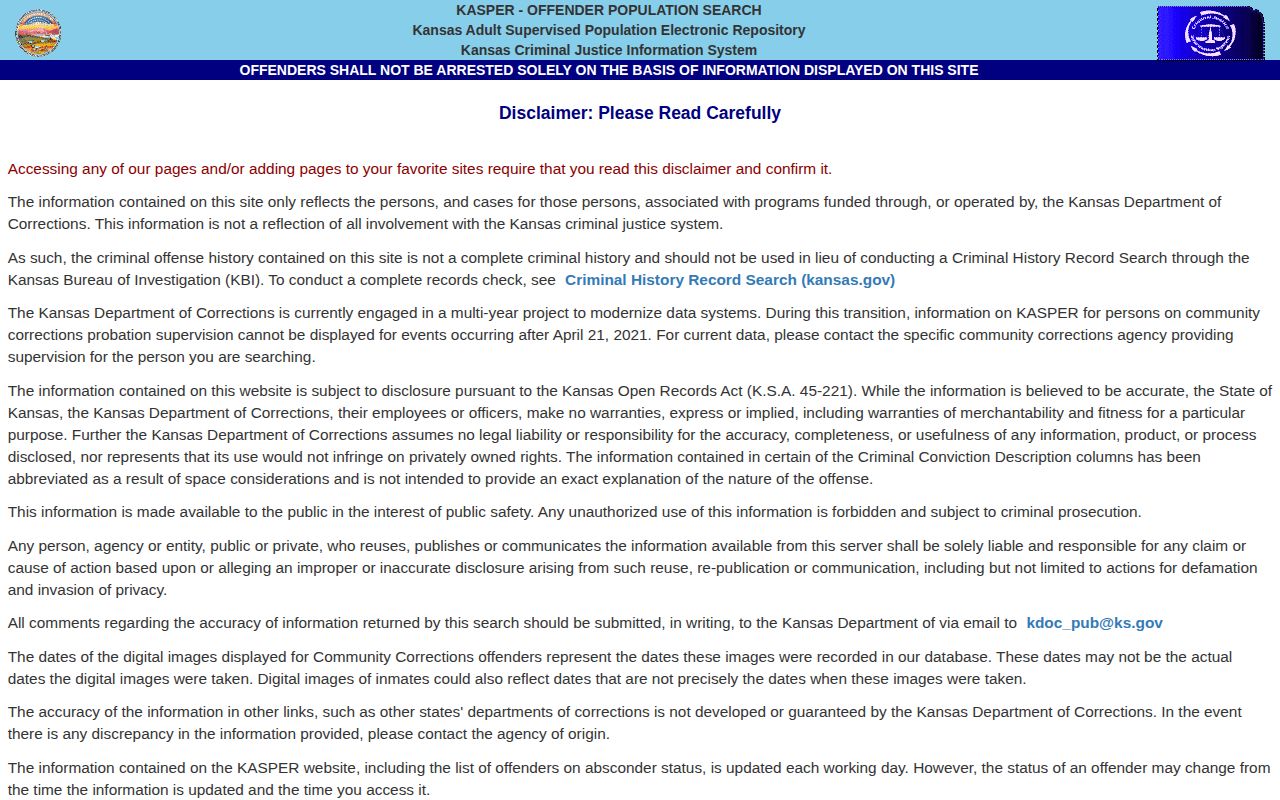
KASPER can supply a state date, but a county release must be checked with Wallace County Jail and the court.
Kansas Credits Shape Wallace Release Dates
K.S.A. 21-6821 authorizes KDOC rules for earning and forfeiting good time on modern guidelines terms. For crimes on or after July 1, 1993, the general maximum is 15 percent of the prison portion. The familiar “about 85 percent” shorthand applies only when full credit is available, earned, and retained.
The statute also has 20 percent categories for specified offense levels and date ranges, plus separate program-credit rules and caps. One percentage cannot be applied to every case. K.S.A. 22-3725 says its older computation does not apply to crimes on or after July 1, 1993. The journal entry and crime date are essential.
Credit affects the prison portion, but it does not always erase the supervision portion that follows. Some special sentence categories can add credit-related time to postrelease supervision. That is another reason an anticipated prison exit must not be labeled the sentence end. Read the custody date, supervision term, and maximum-sentence or discharge information as separate milestones.
Why Wallace Release Dates Change
KASPER warns that anticipated dates can change with credit earnings and forfeitures. Legal and custody changes also matter.
| Factor | Effect | Verify with |
|---|---|---|
| Credits | Move the prison date | KDOC computation |
| Amended sentence | Changes term or jail credit | Court journal entry |
| Consecutive case | Adds another term | Court and KDOC |
| Detainer | May cause transfer | Custodians |
| Parole decision | Affects eligible older cases | Board and KASPER |
| Revocation | Can alter custody | Court or KDOC |
Wallace County Jail Date Computation
A local jail stay may be pretrial detention, a misdemeanor sentence, a felony jail sanction, contempt, probation sanction, or another hold. State-prison percentages should not be copied onto a county term. Use the journal entry, jail-credit finding, bond or court orders, and sheriff movement record.
Identify every active case and hold. Determine whether terms run together or one after another. Ask the actual custodian to compute the term. State assumptions if an estimate is shared. After the event, the release record is stronger evidence.
Wallace County publishes no online release-date calculator and no current or recent-release roster. A local estimate should therefore begin with documents, not a commercial search result. Obtain the signed sentencing journal entry and any later amended entry. Check how much jail credit the court awarded. Then ask the sheriff whether another hold or transfer order appears in the movement record. A county exit can be a transfer to KDOC, another jail, federal custody, or another agency rather than a return to the community.
Pretrial time is especially hard to predict. Bond may be posted, changed, revoked, or subject to conditions. A dismissal in one case may leave another case or hold in place. A future hearing date is not an exit date. The safest statement is that the release depends on the next lawful event until the sheriff records the movement.
Wallace Parole Dates Are Not Grants
The Prisoner Review Board publishes monthly public-comment schedules. Appearance means scheduled consideration, not approval or physical release. For Wallace, match county of offense and case number because the person may be housed elsewhere.
A public-comment session can precede eligibility review and possible release, but the board action and later KASPER status must be checked. Modern determinate terms usually reach release through sentence and credit computation followed by postrelease supervision, not discretionary parole.
The board’s published offender list can help match a Wallace County case because it includes the commitment name, KDOC number, county of offense, case number, and offense. Still, county of offense is not current location. The hearing may occur while the person is housed far from Wallace County. Public comments are participation records, not custody records, and should never be converted into a promised release date.
Wallace Release and Discharge Milestones
Several dates can appear. Parole eligibility is the first point when an eligible indeterminate prisoner may be considered. Conditional release is statutory for a qualifying population. Postrelease supervision follows the prison portion of a determinate sentence. Sentence discharge marks the end of the full obligation.
- Anticipated release
- KDOC’s conditional projection.
- Actual release
- The recorded exit from one custodian.
- Transfer
- Departure to another custodian.
- Discharge
- The end of sentence obligation.
Ask which milestone is being reported. “When are they out?” can hide whether the answer is a projection, transfer, supervised release, or discharge.
Parole and postrelease supervision both place a person outside a prison while legal authority continues. Conditional release is another statutory path for the eligible indeterminate population. A discharged KASPER status is stronger because it indicates the KDOC sentence obligation has ended. Even then, the record should not be stretched beyond its scope; a separate case or another jurisdiction’s order may exist.
Confirm Wallace County Release Timing
KDOC directs date questions to Sentence Computation at 785-296-3317 and KASPER accuracy comments to kdoc_pub@ks.gov. For the jail, call 785-852-4288 and ask for the recorded date, time, authority, and whether the event was release or transfer.
A court entry explains legal authority but not the jail-door time. The Wallace County VINELink inmate search may provide an alert when a matching agency record exists, but registration does not guarantee the projected date.
When contacting Sentence Computation, provide the KDOC number and identify the date or field being questioned. A general request without the person’s record identifier can delay a useful answer. For a court issue, use the case number and ask the Wallace County clerk for the journal entry or later order. Each office should be asked to explain only the record it maintains.
Reconcile Wallace Release Date Records
Use the court file for the sentence and later legal changes. Use KASPER for KDOC custody, supervision, anticipated release, movements, and discharge. Use Wallace County Jail for the county movement timestamp. Use VINE as a notification lead.
If records conflict, note when each was updated and ask its originating office to correct the field. KASPER updates each working day. Wallace publishes no online roster or release feed, making a direct request vital for local custody. The Wallace County release-record search path gives broader request context.
A screenshot records what a portal displayed at one moment. It is not a certified release certificate and may become stale after discipline, restored credit, resentencing, revocation, or a new hold. Save the source, capture time, KDOC number or case number, and exact field label. Then recheck the live system near the anticipated date and contact the responsible office if the answer will guide a pickup, court filing, or other time-sensitive action.
The absence of a KASPER result also needs a narrow reading. The person may never have entered KDOC custody, the name may differ, the record may be restricted, or the transfer may not yet appear. Return to the Wallace court case and sheriff record before concluding that no sentence or movement exists. If the court ordered a KDOC commitment, ask when the person left county custody and then allow for the state system’s working-day update cycle.
For federal custody, the BOP locator can display a release date and “Released” for people in its covered historical records. That shows the end of BOP custody, not freedom from all authorities. The U.S. Marshals Service handles much federal pretrial custody but has no comparable public historical release locator. Federal court records and the holding jail may be needed. ICE ODLS is a separate current-custody tool with limited post-release visibility and is not a Wallace County archive.
No verified ICE detention facility or contract was found in Wallace County. Immigration custody should be checked only when a record points to that route. Likewise, a state prison date should not be used for a local jail term. Custody tier is the key first fact because it decides which agency computes the date and which office records the actual exit.
Public Record Search
Sponsored Results